
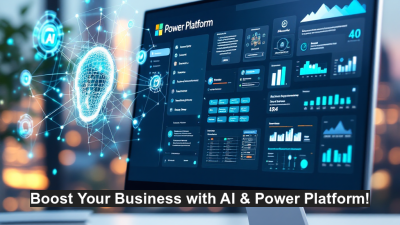
Integrating AI Agents with Microsoft Power Platform: A Comprehensive Guide
————————————————————
Introduction to AI Agents and Microsoft Power Platform
In today’s rapidly evolving technological landscape, businesses are increasingly turning to artificial intelligence to enhance automation and drive decision-making processes. AI agents, with their ability to analyze data, recognize patterns, and even generate intelligent insights on the fly, are becoming indispensable tools across various industries. When integrated with the Microsoft Power Platform, these intelligent agents pave the way for seamless automation and user-friendly application development. The Power Platform, a suite of applications like Power Apps, Power Automate, and Power BI, empowers organizations to create custom solutions without extensive coding knowledge. Key features such as AI Builder and Copilot enable businesses to tailor AI models for specific tasks, including text recognition, sentiment analysis, and forecasting, ensuring that even non-technical users can leverage AI effectively. Furthermore, the integration with Azure OpenAI Service opens up a realm of possibilities by incorporating advanced generative AI capabilities for content generation and personalized customer experiences. This fusion of AI and low-code development not only streamlines processes but also transforms the way businesses harness data for decision-making. To learn more about how these integrations work, you can refer to the detailed insights provided by Integrating AI with Microsoft Power Platform – Skysoft Connections.
————————————————————
Benefits of Integrating AI with Power Platform
The integration of AI agents within the Power Platform brings an abundance of benefits that extend well beyond automation. One of the principal advantages is enhanced decision-making; AI agents can analyze large volumes of data in real time and provide insights that guide strategic decisions. For example, using AI Builder, businesses can create custom AI solutions that perform complex tasks—ranging from text recognition to sentiment analysis—thereby providing actionable insights with minimal manual input. Additionally, the Copilot features available in Power Apps, Power Automate, and Power BI simplify the development of custom workflows and applications by generating code snippets and app components based on natural language descriptions. This minimizes the traditional barriers to entry, such as the need for deep programming knowledge, and accelerates app development cycles.
Moreover, integrating advanced AI capabilities through Azure OpenAI Service enables organizations to provide personalized customer experiences and streamline content generation. The automation driven by AI agents has proven to reduce operational workloads significantly, optimize internal processes, and improve accuracy in task management. As an example of this transformative impact, various organizations have experienced remarkable efficiency boosts by integrating AI technologies with their business platforms. The consolidation of these capabilities results in faster processing times, reduced error rates, and substantial cost savings in terms of operational expenditures. For further insights on these benefits, please refer to the extensive analysis found at Integrating AI with Microsoft Power Platform – Skysoft Connections.
————————————————————
Step-by-Step Guide to Integration
Successfully integrating AI agents with Microsoft Power Platform involves following a systematic and structured approach. Begin by establishing clear objectives that align with your organizational strategy. Defining these goals is crucial as it provides a direction for the integration process and ensures that development efforts yield measurable business outcomes. Once the objectives are set, the next step is pinpointing the specific AI features that can best enhance your workflows.
Start with AI Builder, a tool that allows you to create bespoke AI models without the necessity of in-depth coding. This feature supports a variety of functions such as text recognition, sentiment analysis, and predictive analytics. After building your models, integrate them into your Power Apps to enable intelligent interactions and automate repetitive tasks. Simultaneously, explore the capabilities of Copilot within Power Platform. Copilot helps streamline development processes by generating code snippets or even entire app components based on natural language inputs. These contributions empower citizen developers to actively participate in AI-driven development without relying solely on IT teams.
An essential aspect of this integration is leveraging the Azure OpenAI Service. This service enriches your applications with advanced generative AI capabilities, making it possible to perform tasks like content generation and data summarization. To ensure a robust integration, it’s vital to invest in training both IT and business stakeholders to maximize the utility of these features. Additionally, continuously monitor performance using analytics tools available in Power BI. Regular performance evaluations allow you to identify bottlenecks and fine-tune your integrated solutions accordingly. A detailed guide on this integration process is available at Integrating AI with Microsoft Power Platform – Skysoft Connections.
————————————————————
Real-World Examples and Case Studies
Nothing illustrates the power of integrating AI agents with the Power Platform better than real-world examples. For instance, BDO Colombia harnessed the capabilities of Copilot Studio in tandem with the Power Platform to develop BeTic 2.0—an AI agent designed to centralize and automate payroll and finance processes. The results were impressive: a 50% reduction in operational workload, optimization of 78% of internal processes, and achieving an accuracy rate as high as 99.9% in handling managed requests. This case demonstrates how AI integration can lead to drastic efficiency improvements and reliability in business processes. More details on such transformative implementations can be read from How Agentic AI is Driving AI-First Business Transformation on Microsoft’s official blog.
Similarly, Dow integrated AI agents to automate the analysis of shipping invoices, processing over 100,000 invoices annually. By employing these intelligent agents, Dow was able to identify billing inaccuracies and significantly reduce processing times—from several weeks down to just minutes—resulting in projected multimillion-dollar savings in shipping costs within the first year of implementation. Another outstanding example is Grupo Bimbo, which set up a Technology Center of Excellence leveraging Power Platform solutions along with Copilot Studio. The result was the creation of 7,000 power apps, 18,000 processes, and 650 agents that together generated annual savings running into tens of millions of dollars. These examples underscore that with thoughtful integration, businesses can tackle complex challenges while optimizing both operational efficiency and financial performance.
————————————————————
Best Practices for Successful Integration
Achieving success in integrating AI agents with the Power Platform is contingent on adhering to several best practices that ensure a seamless and impactful implementation. The first cornerstone is to define clear, measurable objectives. Setting well-articulated goals from the outset aligns the project with broader business strategies and prevents scope creep. Equally important is investing in employee training. Providing adequate training not only enhances proficiency in utilizing Power Platform features such as AI Builder and Copilot but also empowers teams to innovate and manage AI-driven solutions effectively.
Monitoring performance is another critical best practice. By leveraging built-in analytics in Power BI, organizations can continuously evaluate the efficiency and effectiveness of their AI integrations, swiftly identifying any issues that require intervention. Moreover, fostering collaboration between IT teams and business units is vital. This collaborative approach ensures that technical solutions are deeply imbued with business-centric insights, therefore addressing genuine operational challenges.
Additionally, responsible AI considerations must be integrated into every phase of the process. Employing diverse and representative training data minimizes biases, while ensuring transparency and accountability in AI operations builds trust and credibility among stakeholders. For comprehensive guidelines on responsible and secure AI implementations, please visit the detailed resources offered by Responsible AI considerations for intelligent application workloads – Power Platform | Microsoft Learn.
————————————————————
Common Pitfalls and How to Avoid Them
While the benefits of integrating AI agents with the Power Platform are abundant, several pitfalls can hinder successful implementation if not proactively addressed. One common mistake is failing to establish clear objectives at the beginning of the project. Without a defined purpose, projects risk diverging from strategic goals, leading to inefficiencies and wasted resources. Another major pitfall is underestimating the importance of comprehensive employee training. Without sufficient training, teams may struggle to fully exploit the capabilities of AI Builder and Copilot, leading to suboptimal performance.
A further challenge is neglecting to monitor and audit AI systems post-deployment. Continuous performance evaluations and security audits are essential to ensure that the integrated systems remain efficient, secure, and compliant with regulatory standards. It is also important to exercise caution with data management practices. Ensuring robust data encryption, both at rest and in transit, along with strict access controls, helps protect sensitive information from potential breaches.
The tendency to work in siloed environments where collaboration between IT and business units is minimal can also impede the success of AI integration. An inclusive and collaborative approach is necessary to address real-world operational problems comprehensively. For detailed security measures and responsible AI guidelines, refer to Security considerations for intelligent application workloads – Power Platform | Microsoft Learn.
————————————————————
Future Trends in AI and Power Platform Integration
The landscape of AI and its integration with platforms like Microsoft Power Platform is rapidly evolving, promising new opportunities that will reshape business processes in the near future. One of the emerging trends is the increasing personalization of AI agents. As generative AI continues to mature, businesses are expected to deploy solutions that provide highly personalized customer experiences and more tailored business insights. The use of natural language processing will become even more intuitive through features like Copilot, enabling non-technical users to engage directly with sophisticated AI algorithms.
Additionally, we can anticipate a stronger convergence between low-code development platforms and advanced AI capabilities. The integration of AI Builder with Azure OpenAI Service, for instance, will likely yield tools that are even more accessible and capable of handling complex tasks. This will not only further democratize AI but also catalyze innovation across sectors. As security and ethical considerations continue to come to the forefront, future developments will need to balance rapid technological advancement with responsible usage. To stay ahead of these trends, continuous learning and adaptation will be essential; exploring insights from experts and up-to-date industry reports can provide valuable direction. To delve deeper into the future directions of AI integration, you can explore further discussions on How Agentic AI is Driving AI-First Business Transformation from Microsoft’s official blog.
————————————————————
Conclusion: Unlocking New Possibilities
Integrating AI agents with the Microsoft Power Platform is more than just a technological upgrade—it’s a transformative strategy that unlocks new possibilities for automation, efficiency, and innovation. By leveraging tools like AI Builder and Copilot alongside the advanced capabilities of Azure OpenAI Service, businesses can create intelligent solutions that not only automate repetitive tasks but also drive strategic decision-making. As demonstrated by the success stories of companies like BDO Colombia, Dow, and Grupo Bimbo, organizations that embrace these integrations benefit from reduced operational costs, enhanced accuracy, and improved process efficiencies.
Ultimately, the journey toward integrating AI with the Power Platform is paved with both opportunities and challenges. The key to success lies in clearly defined objectives, thorough training and collaboration, adherence to responsible AI and security practices, and staying attuned to emerging trends. With the right strategy and careful execution, businesses can harness the full potential of AI to innovate and drive sustainable growth. Embracing this integration today prepares organizations for a future where intelligent automation and data-driven decision-making become the norm.
By following the comprehensive insights and best practices outlined in this guide, you can confidently embark on the path to integrating AI agents with Microsoft Power Platform, unlocking unprecedented efficiencies and opening the door to a new era of business innovation.