
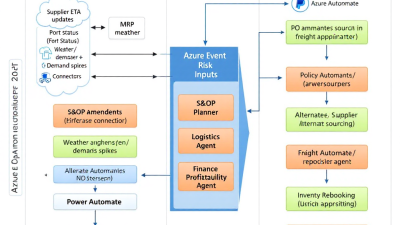
Agentic Supply Chains: Real-Time Replanning Across S&OP, MRP, and Logistics with Microsoft Power Platform
TL;DR: Agentic replanning that overlays your APS/TMS/WMS (not replaces it)
Batch planning can’t keep up with today’s volatility. Layer AI agents on the Microsoft Power Platform to continuously ingest live risk signals—supplier delays, port closures, weather, and demand shocks—and autonomously re-plan supply without ripping out your APS/TMS/WMS. Using Copilot Studio, Power Automate, Dataverse, and Azure, you can evaluate alternates, auto-negotiate, re-book freight, and run what-if simulations that quantify margin and service impact—within robust guardrails and human-in-the-loop approvals. The result: faster decisions, fewer expedites, better OTIF, and lower inventory. Companies that continuously update S&OP plans can cut inventory up to 20% and improve service 5–10% according to McKinsey. With Power Platform connectors and approvals, you can integrate Dynamics 365, SAP, TMS/WMS, EDI, and ITSM tools in weeks, not months, and scale from SMB to enterprise.
Why now: From brittle batch planning to continuous, risk-aware supply chains
– Disruptions are no longer edge cases. The average company will face a month-long disruption every 3.7 years and at least one major event each decade that can wipe out 45% of annual EBITDA, per the McKinsey Global Institute.
– The Red Sea crisis in 2023–2024 stretched Asia–Europe transit times by 10–14 days and doubled spot rates on some lanes, according to the Freightos Baltic Index.
– Meanwhile, hyperautomation and composable architectures are dropping operating costs by up to 30%, says Gartner.
The takeaway: Planning can’t be a once-a-week batch job. It must be a continuous, signal-driven, constraint-aware loop that detects risk, evaluates options, and executes controlled changes across S&OP, MRP, and logistics. Microsoft’s stack already supports signal-driven orchestration, with Dynamics 365 Supply Chain Center and Intelligent Order Management enabling proactive mitigation and re-orchestration that your agents can extend.
Key concept: What “agentic supply chain” means across S&OP, MRP, and logistics
Agentic supply chains use autonomous yet governed AI agents to:
– Sense: Continuously ingest live risk signals from suppliers, ports, carriers, weather, and demand channels.
– Reason: Retrieve relevant policies and contracts, check constraints, and simulate options to quantify margin and service tradeoffs.
– Act: Propose and execute changes—PO amendments, alt-source purchase, carrier rebookings—subject to approvals, Segregation of Duties, and audit.
– Learn: Capture outcomes and feedback loops to improve the next recommendation.
It’s not “replace your APS/TMS/WMS.” It’s an overlay that makes them smarter and faster—augmenting planners while preserving your core investments. AI-enabled planning can reduce forecasting errors by 20–50% and lost sales due to stockouts by up to 65%, per McKinsey.
Reference architecture on Microsoft: Copilot Studio + Power Automate + Dataverse + Azure
– Copilot Studio: Build task-oriented copilots that connect to SAP, Dynamics 365, ServiceNow, and custom APIs, and trigger flows with approvals and guardrails. See Copilot Studio.
– Power Automate: Orchestrate cross-system actions with robust approvals, retries, and exception handling using 1,000+ certified connectors. See the connectors catalog and approvals.
– Dataverse: Store agent context, risk signals, decisions, simulations, approvals, and audit with row-level security and easy export to Data Lake for analytics. See Dataverse.
– Azure OpenAI Service: Power agent reasoning with tool use and function calling behind enterprise controls. See function calling.
– Dynamics 365: Use Planning Optimization for near-real-time MRP and Intelligent Order Management for orchestration across channels—both agent-friendly.
This is classic composability: rapidly assemble capabilities from existing building blocks to accelerate time-to-value, as Gartner’s Composable Business vision recommends.
Ingesting live risk signals: Suppliers, ports, weather, demand, and market data
– Supplier health and delays: EDI 855/856 acknowledgments, ASN variance, promise-date shifts from SAP/Dynamics; supplier portal updates; email scraping for exceptions via Copilot Studio.
– Logistics disruptions: Port closures, strikes, capacity constraints, carrier ETAs; dynamic spot rates; live exceptions from TMS; ocean tracking data and indices like Freightos.
– Weather and geopolitics: Storm tracks, wildfires, customs advisories; geofenced facility impacts.
– Demand signals: E-commerce spikes, B2B backlog, POS, promotions, competitor pricing.
– Market inputs: Commodity prices, FX, fuel surcharges.
Power Platform connectors and custom connectors make ingestion straightforward across SAP, Dynamics, ServiceNow, and more—see the connector catalog. Dataverse serves as the landing zone and feature store for signals and context.
Agent roles and responsibilities: S&OP, MRP, Logistics, Finance/Profitability, and Compliance
– S&OP Agent: Reconciles rolling demand and supply; issues policy-compliant proposals to adjust inventory targets, allocation, and backlog reprioritization. McKinsey shows continuous S&OP updates can reduce inventory up to 20% while improving service 5–10%—a strong case for an always-on S&OP agent (source).
– MRP Agent: Monitors BOM-level supply risk, triggers near-real-time MRP runs (via Planning Optimization) for impacted items, and proposes PO cover, alternates, or reschedules (Dynamics 365 Planning Optimization).
– Logistics Agent: Detects transit risk, auto-requests spot quotes, books alternates, or shifts mode while protecting delivery promises and ATP/CTP. Microsoft’s orchestration stack is built for this (Intelligent Order Management).
– Finance/Profitability Agent: Computes landed cost deltas, expedite fees, and margin-at-risk; flags SLA penalties; surfaces P&L impacts.
– Compliance Agent: Enforces policies (SoD, DLP), export controls, ESG constraints, and contract terms; ensures every action is auditable in Dataverse.
Decisioning core: RAG on policies and contracts, constraint checks, and what-if simulation
– Retrieval-Augmented Generation (RAG): Pull operating policies, supplier contracts, SLAs, and incoterms from Dataverse or SharePoint to ground agent reasoning.
– Constraints: Capacity calendars, MOQ/EOQ, lead times, allocation rules, ATP/CTP, freight cutoffs, labor, and cash constraints.
– What-if simulation: For each option (e.g., expedite current supplier vs. alternate sourcing), simulate service impact (OTIF risk, stockout probability) and economics (landed cost, margin). AI-enabled planning can materially reduce forecast error and stockouts (McKinsey).
– Execution bonding: Proposed actions are packaged with evidence, costs, and approvals. Dataverse stores the full lineage so decisions are explainable and auditable (Dataverse).
– Reason-to-Act: Azure OpenAI function calling lets copilots “call tools” deterministically to run simulations and invoke specific flows safely (Azure OpenAI).
Autonomous actions with guardrails: Approvals, SoD, DLP, and traceability in Dataverse
– Approvals: Route decisions to planners, buyers, logistics, and finance with tiered thresholds and parallel approvals in Power Automate (Approvals).
– Segregation of Duties: Enforce role-based access and dual control for sensitive changes; keep sensitive actions “simulation-only” until approved.
– DLP and Managed Environments: Apply environment-level policies, solution-aware ALM, and data boundaries for scale and safety (Power Platform governance).
– Persistent audit: Every recommendation, simulation, approval, and execution is stored in Dataverse with row-level security and history (Dataverse).
Auto-negotiation and sourcing: Supplier alternates, lead-time/price trade-offs, and EDI/email co-pilots
– Alternate sourcing: The agent evaluates alternates from approved vendor lists, factoring price, MOQ, lead time, and on-time reliability.
– Negotiation co-pilot: Copilot Studio drafts RFQs, negotiates delivery windows or splits, and logs counteroffers; approvals gate any commitments (Copilot Studio).
– EDI and portals: Use connectors and partner gateways for 850/855/856/810 exchanges; auto-compare confirmations to plan (connectors).
– Financial impact: The Finance Agent quantifies landed cost and margin deltas; compliance checks contracts and ESG rules before any PO change.
Freight replans that stick: Carrier rebooking, mode shifts, and delivery promise integrity
– Detect and rebook: When carriers miss cutoffs or ports close, the Logistics Agent requests spot quotes, evaluates mode shifts (ocean-to-air, rail-to-truck), and rebooks within policy.
– Protect promises: Update commitments in ERP/OMS, notify customers, and synchronize ATP/CTP; leverage real-time orchestration proven in Microsoft’s stack (Supply Chain Center, Intelligent Order Management).
– Reality check: In volatile lanes (e.g., Red Sea detours), automated repricing and re-routing can be the difference between hitting SLAs and hemorrhaging margin (Freightos Baltic Index).
Simulating margin & service impact: Landed cost, expedite fees, stockout risk, and SLAs
– Comprehensive cost: Landed cost with duties, FX, fuel, accessorials, expedite fees, and cancellation penalties; service costs for missed SLAs.
– Service risk: Stockout probability, OTIF impact, and customer prioritization; quantify “margin-at-risk” by customer and lane.
– Business case: Digitized planning and execution can add 3–5 percentage points of EBIT and reduce inventory by 15–30%, per BCG.
– S&OP tie-in: Continuous plan updates unlock working capital and service gains (McKinsey).
Integrations without rip-and-replace: Dynamics 365/SAP, APS, TMS, WMS, ServiceNow/Jira, EDI
– ERP/APS: SAP (RFC/OData), Dynamics 365, and common APS via certified and custom connectors; trigger MRP runs, amend POs, update allocations (Power Platform connectors).
– TMS/WMS: Rate shop, tender, rebook, and adjust warehouse waves; raise exceptions; synchronize ASN and appointments.
– ITSM: Open change tickets or incident records in ServiceNow/Jira for escalations and approvals.
– EDI: Leverage gateway partners and custom connectors; centralize EDI events in Dataverse for a unified signal bus.
– Governance: Keep everything behind Managed Environments and DLP; approvals and retries built-in (approvals, governance).
Operational visibility: Power BI KPIs—OTIF, inventory turns, MTTR for disruptions, margin-at-risk
– KPIs: OTIF, inventory turns, plan adherence, exception aging, mean time to replan (MTTR), margin-at-risk by product and lane.
– Data model: Use Dataverse as the operational truth and export to Azure Data Lake for Power BI dashboards (Dataverse).
– Signal-to-action lineage: Trace from disruption signal to executed action and outcome; prove ROI and compliance.
– Microsoft-native signals: Integrate with Supply Chain Center to display external risk signals alongside agent outcomes.
Security & governance: Purview, DLP, audit trails, bias/ethics policies for autonomous actions
– Platform guardrails: Managed Environments, DLP, role-based access, and solution-aware ALM (Power Platform governance).
– Autonomy with control: Configure “simulation-only” for high-risk actions; require dual approvals; enforce SoD for purchasing and logistics.
– AI responsibility: Ground agents with RAG; restrict tools via function calling; log all prompts, context, and actions in Dataverse for auditability (Azure OpenAI, Dataverse).
– Data governance: Classify and monitor sensitive data, and integrate with Microsoft security for monitoring across environments.
SMB to enterprise rollout: 4–8 week pilot plan, success metrics, and scaling patterns
Weeks 0–1: Co-design and data readiness
– Pick one product line or a single lane. Define “golden signals” (e.g., late ASNs, port closure alerts). Map current runbooks and thresholds.
Weeks 2–3: Connect and simulate
– Wire connectors to ERP/TMS/EDI/ITSM; land signals in Dataverse. Stand up a Copilot Studio agent to triage and explain recommended playbooks. Add what-if simulation for 2–3 common scenarios.
Weeks 4–5: Human-in-the-loop execution
– Enable Power Automate approvals; let agents create but not post PO amendments and rebookings; capture ROI metrics (avoided expedites, faster replans).
Weeks 6–8: Guardrails and scale
– Add SoD, DLP, and exception retry patterns. Expand to two more signals or one more region. Publish a Power BI dashboard for MTTR, OTIF deltas, and margin-at-risk.
Success metrics
– 30–50% faster replans (MTTR for disruptions), 15–30% inventory reduction runway identified, reduced expedites and premium freight, and improved OTIF. Composable and hyperautomation approaches consistently reduce costs, per Gartner; customers routinely go live in weeks with Microsoft’s orchestration tools (Intelligent Order Management).
Cost and ROI: Cloud consumption, runbook savings, planner productivity, reduced expedites
– Hard savings: Fewer expedites and premium freight; better carrier utilization; lower safety stock via continuous S&OP (McKinsey).
– Soft-to-hard conversion: Planner hours into value—spend less time triaging and more time on supplier development; 30% operational cost reductions are achievable with hyperautomation (Gartner).
– Strategic upside: Digital planning can add 3–5 points of EBIT margin while cutting inventory 15–30% (BCG).
– Cost drivers: Azure OpenAI, Power Platform run costs, and connector usage—all elastic and controllable with throttles and auto-scaling.
Build vs buy: When to use Copilot Studio UX + n8n/Power Automate orchestration patterns
– Buy pattern: If you’re already on Dynamics 365, lean into Supply Chain Center and Intelligent Order Management for signal ingestion and orchestration, with a Copilot Studio UX layer to reason and approve (Supply Chain Center, IOM).
– Build pattern on Microsoft: Use Copilot Studio for agent UX, Dataverse for context and audit, Azure OpenAI for reasoning, and Power Automate/Logic Apps for actions and approvals. This composes neatly over SAP/APS/TMS/WMS via the connector ecosystem.
– Hybrid/adjacent tools: In organizations with heterogeneous stacks or strict separation-of-concerns, n8n can run certain non-critical automations while approvals, data, and sensitive actions remain in the Power Platform with enterprise guardrails.
Case walk-through: Supplier delay triggers MRP replan, alt-source, and TMS rebook—with approvals
1. Signal: A key supplier pushes a shipment by 12 days via EDI 855 update. A port advisory also flags weather risk. Signals land in Dataverse; the MRP Agent raises a “material-at-risk” alert.
2. Reason: The agent retrieves the supplier contract, MOQ, and pricing (RAG), checks component constraints, and runs a targeted MRP replan via Dynamics 365 Planning Optimization to quantify shortage depth (Planning Optimization).
3. Simulate: Three options are simulated:
– Expedite current supplier by air (adds $2.20/unit; 98.5% OTIF).
– Split order: partial expedite + partial push (adds $1.10/unit; 96.3% OTIF).
– Alternate supplier at +6% price, 5-day lead (adds $1.50/unit; 97.8% OTIF).
The Finance Agent computes landed cost and margin-at-risk; the Logistics Agent checks carrier capacity and delivery promise impact.
4. Propose: The Copilot summarizes tradeoffs and recommends “split order” with a customer-specific allocation to protect top-SLA accounts. It attaches evidence, simulated outcomes, and policy checks.
5. Approve: A Power Automate approval routes to the buyer and logistics manager with SoD enforced. Comments are captured for audit (Approvals).
6. Act: On approval, flows amend the PO in ERP, place an RFQ and award with the alternate supplier, and rebook freight via TMS. Intelligent Order Management updates order orchestration and customer promises (IOM).
7. Learn: Once delivered, actuals are compared to simulation; the agent updates its priors and highlights playbook performance in Power BI.
Checklist: Readiness, data pre-reqs, connectors, and a phased backlog for your first release
Data and systems
– Clean item masters, suppliers, lanes, lead times, carrier contracts, and SLAs.
– Access to ERP (SAP/Dynamics), TMS/WMS, EDI feeds, and ITSM for approvals.
– Dataverse environment with security roles and audit turned on.
Guardrails
– Managed Environments and DLP policies configured; SoD roles defined; approval thresholds set.
– Function calling allowlist for agent tools; simulation-only mode for high-risk actions.
Connectors and flows
– ERP: SAP OData/RFC or Dynamics 365 connectors.
– Logistics: TMS/WMS APIs; rating/tendering connectors.
– EDI: Partner gateway or custom connector.
– ITSM: ServiceNow/Jira connectors.
Backlog for Release 1 (4–8 weeks)
– Scenario 1: Supplier delay → MRP replan → split expedite/alternate → TMS rebook.
– Metrics: MTTR for replans, premium freight avoided, OTIF delta, margin-at-risk reduced.
– Capabilities: Copilot for triage, two simulation templates, approvals, Dataverse audit, Power BI dashboard.
Call to action: Co-design a pilot with B. Cobra Systems—start with one product line or lane
B. Cobra Systems helps you stand up agentic replanning on the Microsoft stack in weeks, not months. We co-design a tightly scoped pilot—one product line, one lane—to prove value, then scale with the right guardrails. If you’re ready to turn your supply chain from reactive to resilient, let’s start with your highest-impact disruption pattern and ship an agent that pays for itself fast.
Supporting sources
– Continuous S&OP improvements (McKinsey)
– Disruption frequency and impact (McKinsey Global Institute)
– Hyperautomation cost reduction (Gartner)
– Signal-driven orchestration in Microsoft stack (Dynamics 365 Supply Chain Center, Intelligent Order Management)
– Copilot Studio for generative copilots and approvals (Copilot Studio)
– Power Platform connectors and approvals (Connectors, Approvals)
– Governance and admin (Power Platform governance)
– AI planning improvements (McKinsey)
– Freight volatility context (Freightos Baltic Index)
– Azure OpenAI function calling (Azure OpenAI)
– Dynamics 365 Planning Optimization (Planning Optimization)
– Composable business (Gartner)
– Digital planning ROI (BCG)
– Dataverse as secure backbone (Dataverse)