
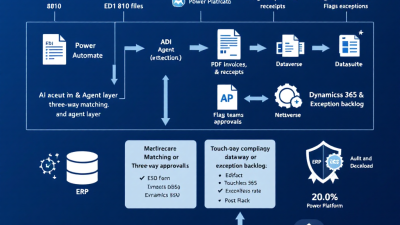
Finance Without Friction: AI-Powered Business Process Automation for AP/AR
Introduction
Accounts Payable (AP) and Accounts Receivable (AR) are where good cash flow meets bad friction: manual invoice entry, exception ping-pong, slow dispute cycles, and mismatched payments that stall revenue and working capital. The timing is right to fix it. By combining Microsoft Power Platform with Azure OpenAI and your ERP/EDI backbone, autonomous finance agents can execute three-way match, resolve invoice exceptions, manage disputes, and automate cash application—touchlessly, consistently, and with a provable audit trail. The payoff isn’t theoretical: Gartner projects that organizations that combine hyperautomation technologies with redesigned processes can cut operating costs by 30% (Gartner). This guide maps a reference architecture on Microsoft Power Platform—spanning Power Automate, Copilot Studio, AI Builder, Dataverse, and Power BI—interfacing with Dynamics 365, SAP, NetSuite, QuickBooks, and EDI. We’ll show how to reduce DSO, increase touchless rates, and shrink leakage while maintaining strict, auditable guardrails.
The cost of friction in AP/AR—and why AI agents fix it now
Friction in AP/AR translates directly into cash drag and margin leakage. In AP, every manual touch—from OCR cleanup to chasing missing POs—extends cycle time and risks overpayment. In AR, delays in dispute handling, correction loops, and manual cash posting inflate DSO and obscure true aging. Add to that the soft costs: inconsistent decisions, tribal knowledge, and fragile workflows tied to inboxes and spreadsheets.
Why now? Three shifts have converged:
– Mature ERP controls and events: Systems such as Dynamics 365 Finance expose robust matching policies and event hooks that automation can safely consume (Vendor invoice matching; Business events).
– Proven AI document understanding: Prebuilt invoice OCR accelerates clean data capture—no custom model science projects required (AI Builder Invoice processing; Invoice capture).
– Enterprise-grade AI privacy and governance: Azure OpenAI keeps prompts/outputs out of model training and supports private networking and customer-managed keys, aligning with finance’s risk posture (Azure OpenAI data privacy).
Finance without friction: touchless ops with auditable guardrails
“Touchless” doesn’t mean “trustless.” Modern AP/AR automation blends deterministic rules with AI reasoning and human approvals inside tight guardrails:
– Deterministic where it matters: Three-way match tolerances, duplicate detection, posting rules, and policy gates remain enforced by ERP and workflow engines (Vendor invoice automation).
– AI where it’s messy: Normalize line descriptions, resolve unit-of-measure differences, classify exceptions, and generate consistent remediation proposals.
– Structured human-in-the-loop: Financial approvals with assignment, escalation, and an immutable history via Power Automate Approvals (Modern approvals).
– Audit, DLP, and RBAC: Dataverse auditing provides field-level change logs with users and timestamps (Dataverse auditing), while Power Platform DLP enforces safe connector boundaries across ERP, EDI, email, and storage (DLP policies). Layer this with security roles in Dataverse/ERP and Azure OpenAI’s enterprise privacy controls (Azure OpenAI).
Reference architecture on Microsoft Power Platform
Here’s a pragmatic blueprint you can implement today:
– Ingestion and understanding
– AI Builder prebuilt Invoice processing for OCR and line-level extraction feeding Dataverse (AI Builder Invoice processing).
– Dynamics 365 “Invoice capture” for native AP ingestion when D365 Finance is your ERP (Invoice capture).
– Orchestration and agents
– Power Automate cloud flows for rules, tolerances, approvals, and ERP posting.
– Copilot Studio agents to converse with users/suppliers, summarize exceptions, and coordinate multi-step remediations.
– Azure OpenAI to interpret remittances, normalize lines, and generate rationale under policy.
– System of record and audit
– Dataverse for exception cases, approvals, dispute artifacts, and agent telemetry—with full auditing (Dataverse auditing).
– ERP/EDI integration
– Dynamics 365 Finance business events (e.g., invoice posted, payment settled) to trigger flows (Business events).
– Premium connectors for SAP and NetSuite for bi-directional AP/AR operations (SAP connector; NetSuite connector).
– Logic Apps B2B/EDI for AS2, X12, EDIFACT trading partner connectivity (Logic Apps B2B/EDI).
– Analytics and insight
– Power BI dashboards using Dynamics 365 Finance analytics for AP/AR plus custom agent metrics (Finance analytics in Power BI).
– AR collections prioritization using Customer payment predictions (Customer payment predictions).
Three-way match 2.0: AI + rules for PO, receipt, and invoice
The control you already trust becomes the foundation for autonomous throughput. Dynamics 365 Finance supports configurable three-way matching policies to compare invoices to POs and product receipts, preventing overcharges and ensuring compliance (Vendor invoice matching). We extend this with:
– AI-enhanced line reconciliation: Use Azure OpenAI to normalize vendor line descriptions, map UOMs, and reconcile multi-line charges to PO distributions—then apply ERP tolerances to decide post vs. exception.
– Intelligent tolerances: Rules account for freight, tax variance, and price breaks; the agent proposes coded adjustments within limits and raises approvals when out of bounds.
– Straight-through posting: When match passes, Power Automate posts directly via ERP APIs or native automation (Vendor invoice automation).
– Auditable exceptions: Failures create a Dataverse case with extracted data, AI rationale, and links to PO/receipt; Approvals capture the decision trail (Approvals; Dataverse auditing).
Invoice exception handling: classification, routing, and auto-remediation
Exceptions are where days go to die. Put them on rails:
– Classification: AI Builder extracts vendor, dates, totals, and line items, while an agent assigns exception types (missing PO, price variance, quantity mismatch, duplicate) using policy prompts (AI Builder Invoice processing).
– Root-cause proposals: The agent checks goods receipts, contract pricing, and prior credits to suggest fixes (request receipt, apply correct price list, split line, initiate change order).
– Routing and SLAs: Approvals go to buyers or AP leads with escalation and reminders (Modern approvals).
– Native-first when applicable: If you’re on D365 Finance, blend these flows with built-in capture and automation features to maximize straight-through processing (Invoice capture; Vendor invoice automation).
Dispute resolution agent for AR: faster, consistent outcomes
Disputes and short-pays derail cash. A Copilot Studio agent can gather context, propose resolutions, and keep everyone aligned:
– Prioritize by risk: Leverage invoice-level late-pay probabilities to triage and sequence outreach (Customer payment predictions).
– Standardize the playbook: Based on dispute reason and contract terms, the agent drafts a response (credit memo, partial waiver, proof-of-delivery request) and packages evidence from ERP and EDI.
– Human checkpoints: Credit/limit changes and write-offs trigger Approvals with a complete history (Approvals).
– Transparent audit: All steps—customer communications, decisions, attachments—are logged in Dataverse cases with auditing enabled (Dataverse auditing).
Cash application agent: remittance parsing and ML-driven matching
Cash app is ripe for autonomy:
– Remittance capture: Parse emails, PDFs, portal exports, and EDI 820s. Logic Apps B2B handles AS2/X12/EDIFACT flows from trading partners (Logic Apps B2B/EDI).
– Matching intelligence: Use Azure OpenAI to interpret references (invoice numbers, POs, shipment IDs), handle short-pays/discounts, and aggregate many-to-one payments. Rules enforce discount eligibility windows and write-off thresholds.
– Post with confidence: When high-confidence, post to Dynamics 365, SAP, or NetSuite via premium connectors (SAP connector; NetSuite connector). Low-confidence cases go to human review with pre-filled proposals.
– Learn and improve: Agent feedback loops adjust matching thresholds and templates based on reviewer decisions.
Guardrails and compliance: approvals, audit trail, DLP, and RBAC
Autonomous doesn’t mean unsupervised. Build defensible controls:
– Approvals everywhere they matter—policy breaches, credits, write-offs—with time-bound escalation (Modern approvals).
– Full audit: Enable Dataverse auditing for entities that store invoice exceptions, disputes, cash application decisions, and configuration changes (Dataverse auditing).
– DLP by design: Separate environments for Dev/Test/Prod; DLP policies restrict exfiltration between data groups (e.g., ERP/EDI connectors allowed, consumer email blocked) (DLP policies).
– Data privacy for AI: Use Azure OpenAI with private networking and, if required, customer-managed keys; prompts and outputs aren’t used to train foundation models (Azure OpenAI data privacy).
– RBAC: Restrict agent operations with Dataverse and ERP roles; log every privileged operation.
ERP/EDI integration patterns (Dynamics 365, SAP, NetSuite, QuickBooks; X12/EDIFACT)
You don’t need to rip and replace to automate AP/AR:
– Event-driven with Dynamics 365 Finance: Subscribe to business events—invoice created/posted, goods receipt, payment settled—to trigger flows and agents (Business events).
– Connector-first for SAP and NetSuite: Use premium connectors to query POs, receipts, invoices, and to post vouchers and cash apps without custom middleware (SAP connector; NetSuite connector).
– EDI hub-and-spoke: Centralize trading partner setup with Logic Apps B2B for AS2, X12, and EDIFACT; standardize 810/850/855/856/820 lifecycles and surface remittances to the cash app agent (Logic Apps B2B/EDI).
– Quick wins with QuickBooks: Use Power Automate connectors to sync invoices, payments, and customer records while keeping agents orchestrated in Power Platform.
Eventing and reliability: queues, retries, and idempotency
Finance flows must be right, not just fast:
– Idempotency keys: Stamp every invoice/cash event with a unique key; store processed keys in Dataverse to prevent duplicate postings.
– Durable queues: Buffer spikes with Azure Service Bus queues between ERP events and agent flows; use sessions for ordered processing (e.g., per vendor).
– Retries and poison handling: Exponential backoff on transient failures; dead-letter queues for investigation with automated rerun actions.
– Outbox/inbox pattern: Write outbound changes to an “outbox” table in the ERP or Dataverse; a poller publishes reliably to downstream systems.
– Observability: Emit business and technical telemetry (case IDs, match outcomes, latency, exception reasons) to Power BI and Application Insights.
KPIs that matter: DSO, touchless rate, leakage, and cycle time
Make the value visible:
– DSO and aging quality: Use Dynamics 365 Finance’s Power BI analytics for AR to track DSO trends and stratify by risk cohort (Finance analytics in Power BI).
– Touchless rate: Percentage of invoices posted and cash receipts applied without human touch; segment by vendor/customer to target improvements.
– Leakage: Dollars lost to out-of-policy variances, missed discounts, and write-offs—captured from agent decisions and approval outcomes.
– Cycle time: End-to-end time from invoice receipt to posting; from cash receipt to application. Baseline using Power Automate Process Mining and re-measure post-automation to prove impact (Process mining).
– Collections prioritization: Use Customer payment predictions to set collector focus and measure promise-to-pay adherence (Customer payment predictions).
Build playbook for devs: components, ALM, testing, monitoring
Treat finance automation like a product:
– Modular components: Separate ingestion, matching, exception, dispute, and cash app into distinct solutions. Store shared policy and tolerance data in Dataverse.
– ALM: Use managed solutions, environment variables, and pipelines for dev/test/prod promotion; lock down production with DLP and role-based access (DLP policies).
– Test harnesses: Unit-test flows with sample invoices/remittances and golden datasets; simulate edge cases (duplicates, split shipments, multi-currency).
– Approval simulations: Validate escalation paths, SLAs, and audit capture before go-live (Modern approvals).
– Monitoring: Centralize telemetry; build Power BI operational dashboards (backlogs, match confidence, exception aging). Alert on thresholds and failures.
Rollout for SMBs: pilot scope, change management, CoE governance
Start narrow, win fast, expand deliberately:
– Pilot scope: Top 10 vendors (highest invoice volume) for AP and top 10 customers for AR. Target three flows—three-way match, invoice exception routing, and cash app remittance parsing.
– Baseline first: Use Process Mining or simple time studies to capture today’s cycle times, touchless rates, and exception volumes (Process mining).
– Change management: Train AP/AR analysts on reviewing agent recommendations; publish a RACI for approvals; maintain a playbook with exception codes and standard responses.
– Center of Excellence: Establish patterns, connectors, and DLP templates; certify solutions; schedule quarterly reviews of KPIs and policy thresholds (DLP policies).
Cost and ROI model: licenses, Azure usage, and value tracking
Build a transparent model:
– Platform costs: Power Automate (per-user/per-flow), AI Builder capacity for invoice OCR, Copilot Studio for agents, Dataverse capacity, and Power BI Pro/Premium. ERP/connectors as needed (SAP/NetSuite).
– Azure usage: Azure OpenAI token consumption, Logic Apps B2B transactions, and optional Service Bus.
– Value drivers: Reduction in manual touches (labor), DSO reduction (working capital interest savings), leakage reduction (policy enforcement and early-pay discounts), and accuracy (fewer rework loops).
– Business case: Anchor the opportunity in hyperautomation benchmarks—30% operating cost reduction when tech and process redesign move together (Gartner).
– Tracking: Create a “Value” Dataverse table capturing hours saved, dollars recovered, discounts captured, and DSO deltas; report monthly in Power BI.
Mini case study: from manual exceptions to >70% touchless
A mid-market distributor (Dynamics 365 Finance + EDI) struggled with 40% of invoices failing three-way match due to line-description variance and unit-of-measure mismatches. We implemented:
– AI Builder invoice extraction to standardize header/line data.
– An Azure OpenAI-enhanced reconciliation that normalized descriptions and mapped UOMs before applying D365 matching tolerances (Vendor invoice matching).
– Dataverse-backed exception cases with Approvals for out-of-policy adjustments (Modern approvals).
– Cash app agent parsing EDI 820 remittances via Logic Apps B2B and posting via ERP APIs (Logic Apps B2B/EDI).
In 90 days, touchless AP posting rose from 52% to 72%, exception cycle time dropped by 43%, and AR cash app auto-match hit 85% for EDI customers. DSO fell by 3.2 days, freeing significant working capital, while Dataverse auditing satisfied quarterly controls testing (Dataverse auditing).
Next steps and CTA: accelerate with B. Cobra Systems
If you’re ready to cut DSO, raise touchless rates, and lock in auditable guardrails, we can help. B. Cobra Systems designs and implements AP/AR agents on Microsoft Power Platform with Azure OpenAI, integrating seamlessly with Dynamics 365, SAP, NetSuite, QuickBooks, and EDI. Typical timelines: a four-to-six-week pilot that proves value, followed by staged rollout. Let’s turn friction into flow—safely, measurably, and fast. Reach out to schedule a discovery workshop and map your AP/AR automation roadmap.
Citations
– Dynamics 365 Finance: Vendor invoice matching, Vendor invoice automation, Invoice capture, Customer payment predictions, Business events, Finance analytics in Power BI
– Power Platform: AI Builder Invoice processing, Modern approvals, Dataverse auditing, DLP policies, Process mining
– Integration and AI: Logic Apps B2B/EDI, SAP connector, NetSuite connector, Azure OpenAI data privacy
– Business case: Gartner on hyperautomation cost reduction