
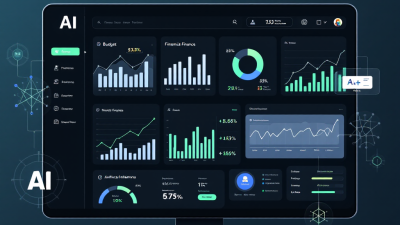
AI Agents in Finance: Revolutionizing Enterprise Resource Planning
In today’s dynamic economic landscape, financial operations are rapidly evolving. Driven by the advent of innovative technologies such as AI agents and generative AI, enterprises are witnessing a paradigm shift in how they manage critical financial tasks. This post explores the transformative impact of AI agents on key financial processes—including budget planning, financial reporting, and wire transfer processing—while highlighting the integration of generative AI with business process modeling to enhance efficiency, compliance, and strategic decision-making.
────────────────────────────
Introduction to AI in Financial Operations
The integration of AI into financial operations marks a significant milestone for enterprises seeking to streamline their processes and gain actionable insights. AI agents, specially designed to operate within the realm of finance, are revolutionizing how tasks are executed by automating complex computations, analyzing massive datasets, and predicting market trends. With advancements in generative AI, finance departments can reduce manual workload and improve accuracy in tasks like budgeting, reporting, and regulatory compliance. As research highlights, the use of Generative Business Process AI Agents (GBPAs) in ERP systems can result in up to a 40% reduction in processing time and a dramatic drop in error rates, thereby delivering both operational efficiency and cost-benefits FinRobot: Generative Business Process AI Agents for Enterprise Resource Planning in Finance.
────────────────────────────
Automating Budget Planning with AI Agents
Budget planning, a cornerstone of financial management, has historically been a labor-intensive process, often fraught with manual errors and delays. Today, AI agents are transforming this space by automating data aggregation, trend analysis, and scenario simulation. By integrating AI-driven insights, finance teams can prepare more accurate and dynamic budgets that adjust in real-time to changes in market conditions or internal shifts. For instance, generative AI not only aggregates historical financial data but also forecasts future trends with impressive precision, aligning with strategic objectives Boosting Efficiency And Maximizing Performance With Generative AI. This shift not only mitigates human errors but also significantly accelerates the decision-making process, ensuring businesses remain proactive rather than reactive.
────────────────────────────
Enhancing Financial Reporting and Compliance
Financial reporting is essential for internal strategic planning and meeting stringent regulatory standards. However, generating accurate and timely reports from sprawling datasets has consistently been a challenge for many organizations. AI agents are now revolutionizing this area by automating data retrieval, performing rigorous data quality assessments, and providing real-time compliance monitoring. These systems can detect anomalies and flag potential adherence issues before they escalate, ensuring that firms maintain a robust internal control framework Four Ways GenAI is Transforming Business Financial Management • Paymo. Additionally, the ability of AI to continuously monitor regulatory changes ensures that finance teams are always aligned with the latest compliance requirements, reducing the risk of financial penalties and reputational damage.
────────────────────────────
Streamlining Wire Transfer Processing
Wire transfer processing, a critical component of transactional finance, involves intricate validations to prevent fraud and ensure the accurate movement of funds. AI agents have demonstrated an exceptional capacity for handling these tasks with minimal human intervention. By leveraging advanced data analytics and robotic process automation (RPA), AI systems can verify transaction details, authenticate sender and recipient identities, and flag suspicious activities in real-time 5 Generative AI in Finance and Accounting Use Cases – Auxis. This automation not only minimizes processing time but also significantly reduces the risk of errors and fraud, ensuring a smoother and more secure flow of funds.
────────────────────────────
Integrating Generative AI with Business Process Modeling
One of the most compelling innovations in modern finance is the integration of generative AI with business process modeling. This dynamic fusion allows organizations to simulate entire financial processes before actual implementation, thereby identifying potential bottlenecks and optimizing workflows. Generative AI agents are trained on vast datasets, enabling them to model complex business processes—from budgeting to compliance—accurately. This integration offers a dual benefit: it enhances process efficiency by eliminating redundancies and improves decision-making by providing AI-driven insights that are both predictive and prescriptive Generative AI in Finance Services – 10 Proven Use Cases. With such tools at their disposal, finance professionals can not only plan better but also pivot their strategies promptly in response to evolving business dynamics.
────────────────────────────
Case Studies: Successful AI Implementations in Finance
Real-world success stories underscore the transformative power of AI agents in finance. For example, several firms leveraging generative AI for budget planning reported a reduction in processing time by up to 40% and witnessed error rates drop by as much as 94% FinRobot: Generative Business Process AI Agents for Enterprise Resource Planning in Finance. Another case study revealed that automated compliance monitoring not only enhanced the detection of anomalies but also significantly cut down compliance-related costs—sometimes by as much as 90%—demonstrating the substantial ROI of such technologies 15+ Generative AI Use Cases That Are Transforming Finance In 2024 – ExpertBeacon. These implementations not only validate the efficacy of AI agents in streamlining financial operations but also offer a blueprint for other enterprises seeking similar improvements.
────────────────────────────
Future Trends and Innovations in Financial AI
The momentum in AI-driven financial processes is unstoppable. Looking ahead, several key trends are poised to redefine the industry further. First, real-time financial analysis powered by AI will become the norm, allowing decision-makers to react instantly to emerging trends and potential risk areas Four Ways GenAI is Transforming Business Financial Management • Paymo. Additionally, the integration of generative AI with RPA is expected to unlock even more sophisticated automation capabilities, expanding the horizon for intelligent finance. As regulatory landscapes evolve, AI tools will increasingly support perpetual compliance monitoring and proactive risk management, ensuring enterprises can maintain robust governance frameworks while focusing on value-driven innovation Generative AI in the Finance Function of the Future | BCG.
Furthermore, AI’s capability to manage legacy systems by understanding and rewriting software code represents a significant development, potentially reducing the need for extensive developer resources and minimizing operational costs 15+ Generative AI Use Cases That Are Transforming Finance In 2024 – ExpertBeacon. These forward-looking innovations confirm that the integration of AI into finance is not a passing trend but a fundamental shift towards smarter, more agile enterprise financial management.
────────────────────────────
Conclusion: The Path Forward for AI in Finance
As demonstrated throughout this post, AI agents are not just a technological novelty but a transformative force shaping the future of financial operations. By automating complex tasks, enhancing real-time data analysis, and ensuring enhanced compliance, AI is setting the stage for a new era in enterprise resource planning. Forward-thinking businesses embracing these technologies gain significant competitive advantages—streamlining operations, reducing risks, and channeling resources toward strategic initiatives.
The journey toward a fully automated, AI-driven finance function is well underway. With increasing adoption of generative AI, RPA integrations, and predictive analytics, the path forward will be one of constant innovation, making financial operations more efficient, compliant, and strategically robust. For leaders in finance and business automation, now is the time to harness the power of AI agents in financial operations and secure a future where technology and strategy move in perfect synergy.
Embracing these advancements not only future-proofs financial management systems but also redefines the role of finance teams—transforming them from data crunchers to strategic enablers in the digital age.