
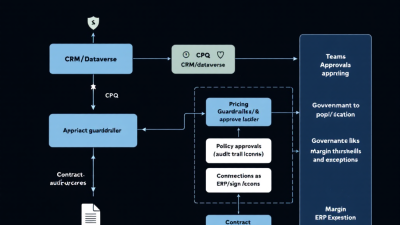
Quote-to-Cash Without Friction: AI Agents for CPQ, Pricing Governance, and Contract Ops
Why Quote-to-Cash Breaks (and How AI Agents Fix It): Speed, margin, and auditability
Quote-to-Cash (Q2C) bottlenecks are predictable: lead quality is inconsistent, quoting rules are buried in tribal knowledge, discounts leak margin, approvals stall in inboxes, and executed terms never make it back into CRM and billing. The result is slow cycles, eroded profits, and painful audits. The data backs it up. Poor contract management alone can drain an average 9.2% of annual revenue—largely through value erosion after signature—highlighting the importance of tying contract obligations and commercial terms back into operational systems (World Commerce & Contracting). On the front end, structured CPQ cuts quote time by roughly 28% and lifts accuracy to near 99%—a clear case for standardization before scale (Forrester TEI on CPQ). Layer in AI on top of a governed process and you accelerate even more: early deployments of AI in sales show 3–5% revenue gains and 10–20% faster lead-to-close times (McKinsey).
AI agents fix Q2C because they consistently apply your rules at machine speed while keeping humans in the loop where judgment matters. With policy-aware prompts, role-based controls, and auditable decisions, agents can pre-qualify, assemble quotes, enforce discount guardrails, route approvals, generate contracts from playbooks, and sync obligations into CRM and billing—closing the loop that often breaks.
Agentic Flow at a Glance: From lead pre-qual to booked order in one governed loop
Here’s the high-level loop most teams can adopt:
– Pre-qualification: An AI Lead Qualifier scores inbound leads against ICP and product fit, enriches missing firmographics, and recommends next steps. High-fit leads auto-create opportunities with initial products.
– Guided quoting: A Deal Desk Agent assembles quotes from a rules-based catalog, checks compatibility, and proposes tiers. A Pricing Guardian enforces discount floors and margin thresholds in real time before a quote moves forward.
– Approvals and negotiation: Exceptions route to the right approvers via Teams, with policy context included. A Contract Counsel Agent proposes redlines from playbooks and flags non-standard terms.
– Signature and sync: Upon signature, the agent synchronizes executed terms, pricing, milestones, and obligations back into CRM and billing/subscription systems and sets follow-up tasks.
– Post-signature compliance: Obligations, renewals, and usage thresholds generate proactive alerts and renewal quotes.
Crucially, you can deliver this on a secure, auditable foundation using Microsoft Copilot Studio “agents,” which perform multi-step tasks with memory and actions while honoring Power Platform security, DLP, audit, and managed environments (Microsoft Copilot Studio).
Core Agent Roles and Hand-offs: Lead Qualifier, Deal Desk, Pricing Guardian, Contract Counsel, Handoff Coordinator
– Lead Qualifier: Scores leads against ICP, persona, geography, and compliance. Enriches with firmographics and surfaces likely product fit. Hands off to Deal Desk when fit and intent thresholds are met.
– Deal Desk: Configures bundles, validates compatibility, suggests alternatives, and drafts quote narratives and ROI snippets. Invokes Pricing Guardian for guardrail checks.
– Pricing Guardian: Calculates pocket margin, applies price lists and discount rules, runs sensitivity analysis, and blocks quotes below floor. Auto-routes exceptions.
– Contract Counsel: Applies clause libraries and playbooks to draft MSAs/SOWs, flags risky deviations, and suggests fallbacks. Syncs obligations on execution.
– Handoff Coordinator: Orchestrates signature, notifies Finance, provisions billing/subscription, and creates customer success tasks tied to contractual milestones.
Each agent exchanges a structured “deal context” record in Dataverse (opportunity, quote, risk, approvals, terms) rather than free-form text, which preserves auditability and enables downstream automation.
Governance by Design: Discount floors, margin thresholds, approval ladders, and exception playbooks
Pricing is leverage. A 1% price increase can deliver an ~8% lift in operating profit on average (McKinsey). Firms that institutionalize pricing excellence sustain 2%–7% margin improvements (McKinsey). And putting guardrails around B2B discounting typically yields 100–300 bps margin uplift within a year (Bain & Company). Encode those economics into your agent policies:
– Discount floors: Absolute and relative floors by SKU, tier, and segment.
– Margin thresholds: Pocket-margin checks after freight, services, rebates, and partner fees.
– Approval ladders: Clear thresholds by role and risk (e.g., CFO >25% TCV discount or non-standard indemnity).
– Exception playbooks: Pre-approved give/get trades (longer term for discount caps, volume commitments for price protection).
– Audit-by-default: Every decision stamped to Dataverse with rationale and approver identity.
Reference Architecture (SMB to Enterprise): CRM/Dataverse, CPQ, pricing engine, document automation, e-signature, billing
At a glance:
– System of record: Dynamics 365 Sales/CRM on Dataverse for accounts, opportunities, quotes, and contracts. Managed Environments, DLP, solution-aware components, and audit logs form the governance backbone (Microsoft Power Platform governance).
– CPQ and pricing: Either native Power Apps for CPQ or integration with existing CPQ. Pricing engine via custom connector to your rate cards or external pricing service.
– Document automation and CLM: Auto-generate MSAs/SOWs and pipe to CLM. With Icertis Contract Intelligence, obligations, clauses, and risk sync with Dynamics 365 and Power Platform for a unified, auditable source of truth (Icertis + Microsoft).
– E-signature: DocuSign, Adobe Acrobat Sign, or Microsoft’s partner connectors with webhook callbacks into Power Automate.
– Billing/subscriptions: Connector to finance/ERP or subscription platforms to create orders, subscriptions, and invoices from the executed contract.
– Agents and orchestration: Copilot Studio agents for multi-step tasks; Power Automate for deterministic flows and approvals (Copilot Studio).
Human-in-the-Loop Safety: Policy-aware prompts, role-based access, and auditable decision trails
Agents must never freelance policy. Use:
– Policy-aware prompts: Embed discount/margin rules, approved fallbacks, and redline constraints into system prompts. Agents propose; humans approve.
– Role-based access: Dataverse security roles ensure agents can read costs but only Finance can see vendor rebates, etc.
– Structured approvals: Teams Approvals for visibility and time-bound SLAs, logged in Dataverse with complete trails. Power Platform gives you tenant DLP, managed environments, and auditing to keep AI actions controllable and reviewable (Power Platform governance).
Power Platform Implementation Blueprint: Dataverse schema, Power Automate orchestration, Teams approvals, and custom connectors
– Data foundation (Dataverse): Tables for Opportunity, Quote, Quote Line, Product, Price List, Discount Rule, Approval, Contract, Clause, Term/Obligation, Renewal, and Risk Assessment.
– Orchestration (Power Automate): Trigger on lead create/update to call the Lead Qualifier agent; on quote draft to call Pricing Guardian; on exception to launch Teams Approvals; on signature webhook to sync terms and create orders.
– Experience (Power Apps): Model-driven app for sales and deal desk; canvas app for approvers with margin visualizations and risk flags. Power Apps speed and ROI are well-documented—188% ROI and 74% faster build cycles (Forrester TEI on Power Apps).
– Approvals (Teams): Adaptive Cards with quote summary, pocket margin, exception rationale, and one-click approve/deny. Power Automate drives substantial time savings—199% ROI and tens of thousands of hours saved annually in composite analyses (Forrester TEI on Power Automate).
– Agents (Copilot Studio): Agents with memory and actions for pre-qual, CPQ assembly, pricing checks, and contract playbooks governed by Power Platform security and DLP (Copilot Studio).
– Connectors: Custom connectors for CPQ/pricing APIs, CLM/e-sign webhooks, ERP/billing endpoints, and usage telemetry.
Data Model Essentials: Quote, line items, price lists, discount rules, approvals, terms, obligations, and renewals
Minimum viable schema elements:
– Quote and Quote Line: Configuration, list price, cost, discounts, taxes, allowances, partner margin.
– Price List and Price List Items: Segmented by region/segment; effective dates; currency; indexation rules.
– Discount Rule: Floor, target, approval threshold, give/get rationale, derived pocket-margin minimums.
– Approval: Requested by, policy reference, SLA, approvers, decision, timestamp, comments.
– Contract and Clause: Template, negotiated variant, fallback hierarchy, risk score.
– Terms/Obligations: Delivery milestones, service levels, usage caps, price protections, renewal windows.
– Renewal: Renewal date, uplift rules, auto-renew state, notice obligations.
Integration Patterns: CPQ and pricing APIs, CLM/e-sign providers, billing/subscription systems, and webhooks
– CPQ/pricing: Synchronous API calls for real-time price and margin validation from the Pricing Guardian; asynchronous batch for price list refreshes.
– CLM and e-sign: Webhook on signature to trigger obligation extraction and synchronization of key terms back into CRM—an approach supported by platforms like Icertis integrating with Dynamics 365 and Power Platform (Icertis + Microsoft).
– Billing/subscriptions: After contract effective date, create orders/subscriptions with proration, entitlements, and billing schedules via connector; register webhooks for usage or milestone events.
– Event-driven automation: Use Dataverse change events and Power Automate to propagate state transitions and keep audit logs consistent.
Guardrails That Protect Margin: Real-time price checks, sensitivity analysis, and simulated deal outcomes
– Real-time checks: Each discount change triggers a recalculation of pocket margin that includes COGS, services, rebates, partner fees, and shipping. Quotes below floor are blocked, with an exception path to the approval ladder.
– Sensitivity analysis: Agents run what-ifs—“What if quantity +20%?” “What if term 24 months?”—to surface defendable alternatives aligned to your give/get playbook.
– Simulated outcomes: For larger deals, simulate annualized GM and NRR under scenarios (e.g., usage growth ±15%, renewal at target uplift). This lets approvers compare a “safe” path vs. “stretch” concessions.
– Pricing excellence linkage: These controls operationalize the margin upside quantified by McKinsey and Bain (McKinsey; Bain & Company).
Legal & Contract Ops: Clause libraries, playbooks, risk scoring, and automatic obligation sync back to CRM
– Clause libraries and playbooks: Maintain standard, fallback, and last-resort clauses with business rationales. The Contract Counsel Agent proposes redlines consistent with playbooks and flags deviations.
– Risk scoring: Score contracts by indemnity caps, termination rights, data processing requirements, and non-standard obligations. Route high-risk deals to Legal leadership.
– Obligation sync: After signature, AI-extracted obligations and key terms sync into CRM and billing to prevent leakage and drive compliance—an approach well supported by CLM platforms integrated with Dynamics 365 (Icertis + Microsoft). This directly addresses the post-signature erosion risks highlighted by WCC’s 9.2% figure (WorldCC).
– Cycle time gains: Organizations using CLM typically reduce contract cycle time by 30–50% while improving compliance and obligation management (Gartner insights).
Testing & Reliability: Sandboxes, synthetic scenarios, regression prompts, and drift monitoring
Treat AI agents like mission-critical software:
– Sandboxes and seeded data: Use a Power Platform sandbox with synthetic accounts, products, clauses, and redline histories.
– Synthetic scenarios: Codify typical and edge cases—multi-year prepay, partner deals, data residency restrictions—and require deterministic outcomes where policy dictates.
– Regression prompts: Maintain a suite of prompts and expected responses; run on each agent update to detect regressions.
– Drift and quality monitoring: Track approval override rates, exception frequency, and hallucination detection. Keep a human-in-the-loop for all non-standard actions, and use audit logs to review agent rationales.
– Change management: Use solution layering, deployment pipelines, and feature flags for gradual rollout in managed environments (Power Platform governance).
KPIs that Matter: Cycle time, approval SLA, discount compliance, gross margin, and win rate uplift
– Quote cycle time: Lead-to-quote and quote-to-signature durations.
– Approval SLA: Median and 90th percentile approval times; auto-approved vs. escalated rates.
– Discount compliance: % of quotes within policy; exception rate and variance.
– Gross margin: Pocket margin by segment and product, pre/post program.
– Win rate and ASP: Lift in conversion and average selling price due to better guidance.
– Contract performance: SLA adherence, uplift at renewal, and leakage recovery from obligation management.
– Automation ROI: Hours saved, manual touches removed—benchmarkable against independent studies on Power Automate and Power Apps ROI (Forrester on Power Automate; Forrester on Power Apps).
Crawl–Walk–Run Roadmap: Start with approvals and pricing guardrails, then automate contract ops and billing sync
– Crawl (Weeks 1–6): Implement discount floors and margin checks in a Power Apps CPQ, route exceptions via Teams Approvals, and deploy a basic Lead Qualifier. Measure cycle time and exception rates.
– Walk (Months 2–4): Introduce Contract Counsel Agent with clause playbooks, integrate e-sign, and sync key terms/obligations back to CRM. Add pricing sensitivity analysis and give/get logic.
– Run (Months 4+): Integrate billing/subscription provisioning, add renewal forecasting, and expand agents to handle partner deals and advanced simulations. Tighten governance with managed environments, DLP refinements, and drift monitoring. Augment with CLM to target 30–50% contract cycle reduction (Gartner insights).
Mini Case Vignette: How an SMB SaaS firm cut quote cycle time by 40% and gained 2 margin points
An SMB SaaS company selling tiered subscriptions struggled with ad hoc discounting and slow approvals. In six weeks, they:
– Built a Dataverse-backed CPQ in Power Apps with price lists and discount rules.
– Deployed a Pricing Guardian agent with pocket-margin checks and exception routing in Teams.
– Introduced a Contract Counsel agent using clause playbooks for data protection and liability caps.
– Synced executed terms and obligations from CLM into CRM and their subscription system.
Results after 90 days: quote cycle time down 40%, exception rate down 35%, and gross margin up 200 bps—consistent with the uplift patterns seen in pricing excellence and discount governance programs (McKinsey; Bain & Company). Automation of approvals and routine tasks delivered measurable time savings, mirroring broader findings for Power Automate programs (Forrester TEI). While illustrative, this pattern is repeatable for SMBs with disciplined governance.
Action Checklist: Readiness assessment, data hygiene, policy codification, and a 4–6 week pilot plan
– Readiness and hygiene
– Cleanse products, price lists, and costs; define a single source of truth in Dataverse.
– Document discount floors, margin thresholds, and approval ladders.
– Inventory standard contracts, clause variants, and playbooks.
– Governance setup
– Configure Managed Environments, DLP policies, audit logging, and security roles in Power Platform (Power Platform governance).
– Establish approval SLAs and escalation paths in Teams.
– Pilot build (Weeks 1–2)
– Stand up a model-driven Power App for CPQ with Dataverse tables (Quote, Line, Discount Rule, Approval).
– Create a Teams Approval flow and exception routing in Power Automate.
– Deploy a basic Lead Qualifier agent and integrate with Dynamics 365.
– Expand (Weeks 3–4)
– Add the Pricing Guardian agent with real-time pocket-margin checks and sensitivity analysis.
– Generate contracts from templates; connect to CLM/e-sign with webhooks.
– Validate (Weeks 5–6)
– Run synthetic scenarios and regression prompts; measure baseline KPIs (cycle time, discount compliance, margin).
– Train approvers, finalize playbooks, and plan phased rollout.
– Scale (Post-pilot)
– Sync obligations to CRM/billing; add renewal automation.
– Implement drift monitoring, analytics dashboards, and continuous improvement.
The payoff is compelling: faster cycles, stronger margins, and airtight auditability—delivered on a governed Power Platform stack with agents that follow your rules, not the other way around. Combine the operational rigor of CPQ and CLM with AI agents and you’ll protect margin while accelerating deal velocity—exactly what revenue operations was meant to do.