
AI Agents in Customer Service: Balancing Efficiency and Human Touch
Introduction to AI Agents in Customer Service
In today’s fast-paced digital world, customer service is rapidly evolving with the help of artificial intelligence (AI). AI agents have shifted from being mere automated response systems to intelligent assistants capable of handling complex queries and supporting human agents in real time. These tools are not only streamlining the resolution process but also enhancing business performance. For example, companies like Verizon have integrated Google’s state-of-the-art AI assistant into their operations, witnessing impressive improvements in sales performance and operational efficiency. This transformation represents a dual focus: while AI systems drive efficiency by reducing call times and automating routine tasks, they also must make room for the human touch that builds trust and empathy with customers. Achieving the right balance between efficiency and personalized service is now a vital strategic concern for businesses looking to excel in customer service.
Case Study: Verizon’s Integration with Google’s AI Assistant
Verizon’s adoption of Google’s AI assistant in their customer service operations is a prime example of how AI can create significant business impact. Powered by Google’s Gemini large language model and trained on approximately 15,000 internal documents, this AI tool now assists Verizon’s 28,000 customer service agents by providing them with real-time support. This integration has led to a nearly 40% increase in sales, an achievement that underscores the potential of AI-enhanced customer service in driving revenue growth. The tool helps reduce call times and frees up agents to focus on more complex tasks such as upselling or addressing unique customer problems—functions that require intuitive interpersonal skills. For more detailed insights on how this transformation unfolded, see Verizon says Google AI for customer service agents has led to sales jump.
Beyond Verizon, other companies are also harnessing the power of AI. Comcast, for instance, has introduced an AI-powered feature called “Ask Me Anything” (AMA) that allows agents to query a large language model in real time. This capability results in about 10% faster response times per interaction and delivers significant annual cost savings. These case studies highlight not only the scalability and versatility of AI tools in customer service but also their potential to enhance agent effectiveness and drive business outcomes.
The Role of Efficiency in AI Solutions
Efficiency is one of the most compelling benefits of integrating AI agents into customer service. By automating tasks that traditionally required long manual input and eliminating repetitive queries, AI systems have revolutionized the way companies operate. AI’s ability to provide quick, accurate information means that agents can spend less time handling mundane tasks and more time engaging in actions that drive sales and customer loyalty.
For instance, Verizon’s implementation of the AI assistant supports their human workforce by streamlining the process of accessing critical information. By doing so, the AI reduces the burden on agents, decreases average call times, and allows for a concentration on complex queries and personalized customer journeys. In tandem, Comcast’s “Ask Me Anything” feature demonstrates the practical benefits of AI in real-time support, achieving around a 10% improvement in engagement speed. These examples underline the potential of AI to not only boost operational efficiency but also to translate that efficiency into measurable financial gains. Such enhancements in customer service workflows are increasingly important in industries where response speed and accuracy are critical.
Furthermore, the integration of AI into customer service operations is leading to significant operational cost reductions. Companies that have adopted a hybrid approach—merging AI capabilities with human expertise—have reported improvements of up to 35% in cost efficiency. The future of customer service lies in creating a synergistic relationship between intelligent systems and human agents, ensuring that the benefits of AI are fully realized without sacrificing the quality of customer interactions.
Maintaining Human Empathy in AI Interactions
Despite the profound efficiency gains from AI, one of the most critical challenges is maintaining human empathy within customer interactions. Customer service is inherently relational, and while AI systems can provide speed and efficiency, they often lack the subtlety and nuanced understanding that human agents bring to the table. Research from Harvard Business School has shown that customers highly value human empathy and are willing to wait longer for a personalized, empathetic response over an instant but impersonal solution. This sentiment is echoed across industries and emphasizes the importance of integrating emotional intelligence into customer service models.
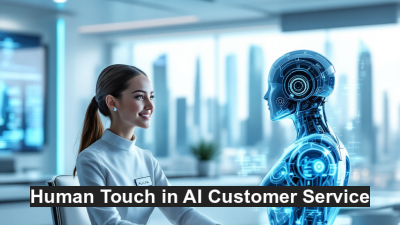
Companies must therefore adopt a hybrid strategy that leverages AI to handle repetitive or data-intensive tasks while allowing human agents to focus on the more emotional and complex aspects of customer service. By blending rapid, AI-driven responses with the warmth and understanding inherent in human communication, organizations can create a more robust and satisfying customer experience. In practice, businesses that have successfully combined AI with human involvement have seen a 25% boost in customer satisfaction, a critical metric in today’s competitive service landscape.Human Interaction vs. Robotic Responses in Customer Service.
This balanced approach ensures that while customers receive fast and accurate responses, they also benefit from the understanding and empathy that only human agents can provide. It reinforces the message that technology should enhance, rather than replace, the personal connections that are vital to customer loyalty and trust.
Lessons Learned and Future Trends
The journey towards AI-enhanced customer service has provided several valuable lessons. First, the importance of a hybrid model cannot be overstated—a strategy that couples the speed and efficiency of AI with the emotional intelligence of human agents is essential. Both Verizon and Comcast demonstrate that while AI improves operational metrics like call times and sales efficiency, the preservation of a human touch remains a non-negotiable aspect of outstanding customer service.
The future of AI in customer service is likely to see further integration of advanced machine learning models and natural language processing systems, enabling even more sophisticated real-time support. Innovations such as sentiment analysis and predictive customer insights will empower agents to tailor their interactions, ensuring that each encounter is both efficient and empathetic. Additionally, businesses will increasingly invest in training their human agents to work seamlessly alongside AI tools, emphasizing the development of soft skills that complement technological capabilities.
Looking ahead, emerging trends include the growing use of AI for proactive customer engagement—anticipating issues before customers even express them. This paradigm shift from reactive to proactive support relies on vast amounts of data and predictive analytics, promising a future where customers experience minimal friction during their interactions with service providers. Furthermore, as AI systems become more adept at understanding context, cultural nuances, and emotional cues, the gap between automated and human responses is expected to narrow, paving the way for a more integrated and personalized customer service experience.
In conclusion, the incorporation of AI agents in customer service is revolutionizing the industry by driving efficiency and boosting key performance indicators such as sales. However, maintaining a balance with human empathy is paramount to ensure that customers feel truly valued. The experiences of companies like Verizon and Comcast offer a roadmap for success, but they also serve as a reminder that technology should enhance, not replace, the human aspect of customer care. By embracing a hybrid approach that leverages the strengths of both AI and human agents, businesses can look forward to a future of improved customer satisfaction, streamlined operations, and sustained growth.