
Continuous Controls, Zero Surprises: AI Agents for Real-Time SOX/ISO Compliance
The audit fire drill is over: Why continuous controls matter now
Annual audit season shouldn’t feel like a warehouse sale on stress. Yet many teams still scramble to collect samples, rebuild narratives, and track down evidence across ERP, CRM, HRIS, and ticketing tools. The cost of that scramble is rising. Companies now spend an average of $2.1 million annually on SOX compliance, with costs increasing as environments grow more complex, according to the 2024 Protiviti SOX Compliance Survey. Meanwhile, regulators continue to find gaps. The PCAOB’s 2022 inspections reported elevated ICFR deficiency rates, with more than 40% of audits at some firms having one or more deficiencies—evidence that control failures are still slipping through periodic testing cycles (PCAOB 2022 Inspection Observations).
The profession is signaling the path forward. The Institute of Internal Auditors has long noted that continuous auditing and monitoring enables more timely identification of control deficiencies and shifts assurance from periodic to ongoing (IIA GTAG 3). And ISO/IEC 27001:2022 explicitly expects organizations to monitor, measure, analyze, and evaluate ISMS performance on a planned, ongoing basis—continuous by design (ISO/IEC 27001:2022).
Translation: the audit fire drill becomes a dashboard. Continuous controls monitoring (CCM) with AI agents creates always-on assurance that catches exceptions quickly, produces audit-ready evidence in real time, and materially reduces manual testing and last-minute heroics.
What continuous controls monitoring (CCM) means in 2025 for SOX and ISO 27001
CCM is not a buzzword; it’s a discipline. Gartner describes CCM as technology that tests and reports on business process controls in real time, improving risk coverage and reducing time to detect exceptions (Gartner’s CCM overview). In 2025, CCM for SOX and ISO 27001 means:
– Event-driven testing rather than quarterly sampling
– Full-population analytics on key controls where feasible
– Risk-based sampling where 100% testing is impractical
– Automated evidence collection and narrative generation
– Always-current dashboards for control owners and auditors
This aligns directly to ISO 27001’s performance evaluation clause and the IIA’s continuous assurance guidance, and it provides the operational backbone to improve ICFR reliability throughout the year.
From chatbots to control bots: How AI agents observe, test, explain, and evidence
Most teams have experimented with chatbots. Control bots are different. They are specialized AI agents that:
– Observe: Subscribe to events and logs from ERP/CRM/HRIS, ticketing, identity, and collaboration tools.
– Test: Execute deterministic checks (rules/analytics) against control objectives, with LLMs assisting in data normalization and summarization—not inventing facts.
– Explain: Generate concise, grounded narratives describing what was tested, what evidence was reviewed, and the result.
– Evidence: Assemble and hash artifacts (exports, screenshots, approvals, logs), capture timestamps and lineage, and store links to immutable records.
ISACA emphasizes that continuous monitoring automates the collection and analysis of data to identify control exceptions, enabling faster remediation and lower audit costs (ISACA on Continuous Monitoring). The goal is not an AI that “judges” controls, but a system that executes tests consistently, flags what matters, and documents the evidence trail a human would otherwise assemble manually.
Reference architecture on Microsoft Power Platform
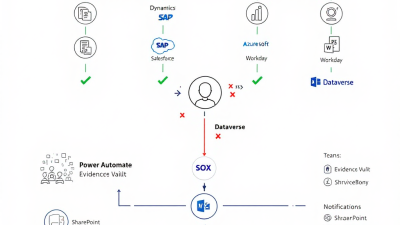
Power Platform provides a pragmatic foundation for CCM and AI agents that live where your business already works:
– Dataverse as the evidence and results hub: Store control definitions, test runs, exceptions, artifacts, and lineage in tables with audit history.
– Power Automate flows for orchestration: Event-driven cloud flows ingest transactions, approvals, and logs; Desktop flows handle thick-client steps where needed.
– Azure OpenAI/LLM services for grounded narratives: Use LLMs to summarize test steps and produce auditor-friendly descriptions grounded in retrieved records and metadata.
– Connectors and virtual tables: Connect to D365, SAP, NetSuite, Salesforce, Workday, ServiceNow, M365/Azure AD, and more. Use virtual tables to work with external data without replication when appropriate.
– Microsoft Compliance Manager: Leverage continuous assessments, improvement actions, and evidence collection capabilities; orchestrate tasks and evidence via APIs to keep controls and artifacts synchronized (Microsoft Compliance Manager).
– Copilot-integrated experiences: Provide control owners with natural-language summaries and exception triage grounded in Dataverse records (Power Platform and Copilot).
– Security and governance: Apply environment strategies, DLP policies, and role-based access with Azure AD and M365 controls.
Microsoft’s own guidance highlights how Power Automate automates repetitive tasks and integrates via connectors, while Copilot generates grounded summaries and audit-ready outputs (Power Automate; Copilot overview).
Systems coverage: D365 Finance/BC, SAP, NetSuite, Salesforce, Workday, HRIS, M365/Azure AD logs, ServiceNow
A credible CCM program must span the systems where controls live:
– Financials/ERP: Dynamics 365 Finance/Business Central, SAP, NetSuite
– CRM/Revenue: Salesforce, Dynamics 365 Sales
– HR/Payroll: Workday and common HRIS platforms
– Identity and collaboration: Azure AD sign-in/audit logs, M365 Purview events
– ITSM and change: ServiceNow, Jira
– Data movement: Integration platforms and data gateways
Patterns to achieve coverage include standard connectors, custom connectors over REST/SOAP APIs, event webhooks, virtual tables to avoid replication, and the on-premises data gateway where needed. The agent subscribes to events (e.g., vendor change, journal entry posted, access granted, change deployed) and runs contextual tests immediately.
Mapping control objectives to agent skills: Access reviews, SoD, change management, P2P, O2C, hire-to-retire
Think of each control objective as a “skill” your agent can execute repeatedly:
– Access reviews: Compare active users and roles from Azure AD/ERP against owner-approved rosters; route quarterly certifications; log approvals and reminders.
– Segregation of duties (SoD): Evaluate role combinations and user activity against SoD matrices; flag conflicts; verify mitigations exist and are current.
– Change management: Cross-check change tickets, approvals, peer reviews, and deployment logs; ensure emergency changes followed expedited but approved paths.
– Procure-to-pay (P2P): Validate three-way matches, vendor master changes with dual approval, price/quantity tolerances, and payment runs with proper authorization.
– Order-to-cash (O2C): Check credit approvals, discount policy exceptions, manual revenue recognition entries, and price overrides.
– Hire-to-retire: Ensure timely provisioning/deprovisioning, manager approvals, privileged access reviews, and termination access removal within SLA.
Each skill combines deterministic checks (rules, thresholds, SoD matrices) with AI assistance for normalization and narrative generation. Deloitte describes CCM implementations that test 100% of transactions for key controls using rules and analytics, reducing cycle times and increasing coverage (Deloitte on CCM).
Risk-based and stratified sampling: How agents pick transactions and adapt sampling with anomaly scores
Where full-population testing is impractical, agents use risk-based sampling:
– Stratify by amount, vendor/customer risk, new suppliers, GL account sensitivity, or user privilege level.
– Calibrate sample sizes based on control criticality and historical exception rates.
– Use anomaly scores (e.g., outlier detection on amounts, timing, sequence, master data changes) to prioritize review.
– Shift left when risk rises: temporarily move from sample-based to full-population checks for a control if exceptions spike.
Gartner’s CCM framing favors real-time analytics to shorten detection time (Gartner CCM), while ISACA underscores automated identification of control exceptions (ISACA). In many P2P/O2C scenarios, organizations can push toward 100% testing on key attributes as Deloitte notes (Deloitte CCM).
Evidence that auditors accept: Immutable logs, file hashes, timestamps, lineage, and narrative generation
Audit-ready means reproducible, complete, and trustworthy:
– Immutable logs: Use Dataverse audit history and append-only records for test runs and outcomes.
– File hashes and versioning: Hash exported reports and screenshots; store checksum, timestamp, source system, and user context.
– Provenance and lineage: Link each test to the control definition, data source, query or API endpoint, and the specific records examined.
– Time-bound completeness: Capture when the sample was drawn and when the test executed; store the query filters so samples can be re-pulled.
– Narrative with citations: Generate concise descriptions of the test, the evidence examined, the result, and any thresholds or exceptions—grounded in the stored artifacts.
– Assessments tie-in: Synchronize with Compliance Manager assessments to consolidate evidence, actions, and status across frameworks (Compliance Manager).
The outcome is a body of evidence aligned to external expectations for ICFR and ISMS monitoring—positioned to reduce findings like those the PCAOB continues to report (PCAOB inspection observations).
Exception management: Flag, route, remediate, re-test with Teams approvals and ServiceNow/Jira tickets
When exceptions occur, speed matters. Design the loop:
– Flag: The agent creates an exception record with context, severity, and recommended next steps.
– Route: Power Automate posts to the control owner’s Teams channel, opens a ServiceNow/Jira ticket, and sets an SLA clock.
– Remediate: Owners attach corrective actions, approvals, or mitigating controls; the agent monitors linked tickets for progress.
– Re-test: On closure, the agent re-runs the specific control and documents the retest evidence and result.
– Escalate: Auto-escalate if SLAs miss; include executives in weekly rollups.
Human-in-the-loop and least privilege: Reviewer gates, sign-offs, and auditor read-only workspaces
AI agents shouldn’t replace accountability; they should streamline it.
– Reviewer gates: Require human review for high-severity exceptions, SoD conflicts, and policy overrides.
– Sign-offs: Quarterly certifications and control attestations route to named owners; e-signature or Teams approval responses are stored with evidence.
– Read-only auditor workspaces: Provide external auditors and internal audit with read-only access to dashboards, evidence, and lineage—no production write access.
– Least privilege always: Use Azure AD roles, environment security, and field-level security to ensure agents access only what they need, and reviewers see only their scope.
Guardrails and trust: Grounding to system-of-record, deterministic prompts, DLP policies, environment strategy
Trust is designed, not declared.
– Grounding: Retrieval-augmented generation (RAG) binds LLM outputs to specific records and artifacts; responses include links back to evidence.
– Deterministic prompts: Use templates and function calling to keep LLMs focused on summarization and classification—not decision-making.
– DLP and environment strategy: Apply Power Platform DLP policies to prevent data egress to non-compliant connectors; isolate dev/test/prod with solution-based ALM and managed identities.
– Sensitive data: Use M365 sensitivity labels and data minimization; redact PII in narratives where not required.
– Telemetry and alerts: Monitor agent behavior, flow failures, and unusual data access patterns.
Performance and ROI: Control coverage, exception rate, MTTD/MTTR, hours saved, reduction in audit adjustments
Measure what matters:
– Coverage: Percent of key controls tested automatically and frequency of testing
– Exceptions: Volume, severity mix, and true-positive rate
– Speed: Mean time to detect (MTTD) and mean time to remediate (MTTR)
– Effort saved: Hours eliminated from manual sampling, evidence collection, and narrative writing
– Audit impact: Reduction in audit adjustments and rework
Automation in compliance and control testing typically reduces manual effort 30–50% and accelerates issue detection using analytics and AI (McKinsey on next-gen risk and compliance). That efficiency compounds against a rising cost baseline cited by Protiviti (Protiviti 2024 SOX survey).
Build it on Power Platform: Event-driven triggers, virtual tables, custom connectors, and low-code orchestration
Practical implementation patterns:
– Event-driven triggers: Webhooks from ERP, ServiceNow, and Azure Event Grid feed Power Automate flows that run control tests immediately.
– Virtual tables: Expose SAP or Salesforce entities as virtual tables in Dataverse to avoid data duplication while enabling low-code logic and security.
– Custom connectors: Wrap unique APIs (e.g., legacy HRIS) with custom connectors that enforce auth, schema, and throttling.
– Desktop automation: For edge cases trapped in desktop clients, use Power Automate Desktop to capture evidence consistently.
– Low-code orchestration: Compose tests as modular child flows; store configuration in Dataverse so non-developers can tune thresholds and sampling rules.
– Copilot experiences: Offer “Explain this exception” or “Draft remediation plan” helpers that cite the evidence they summarize (Power Automate; Copilot).
Implementation playbook (6–8 weeks)
Week 1–2: Plan and prepare
– Prioritize 6–10 controls across P2P, O2C, access, and change management.
– Validate connector readiness and API access; define environments and DLP.
– Draft control-to-agent skill mappings and evidence requirements.
Week 3–4: Build and integrate
– Stand up Dataverse schema for controls, runs, exceptions, and artifacts.
– Implement connectors, virtual tables, and event triggers.
– Build 3–5 control tests end-to-end, including exception routing and retest loops.
– Configure Compliance Manager assessments and link evidence where applicable.
Week 5–6: Pilot and harden
– Run in parallel with existing controls; compare results and calibrate thresholds.
– Add LLM summaries with strict grounding; complete reviewer gates.
– Set dashboards, KPIs, and weekly exception review cadence.
Week 7–8: Rollout and enable
– Expand to remaining pilot controls; finalize playbooks and runbook.
– Train control owners and process SMEs; open auditor read-only workspace.
– Agree on quarterly attestation cycle and continuous improvement backlog.
Change management and training: Control owner enablement, playbooks, and reporting cadence
– Role clarity: Define who owns which controls, who reviews exceptions, and who approves remediations.
– Playbooks: Step-by-step guides for each control—what triggers, what’s tested, evidence stored, and how to resolve.
– Training: Short, scenario-based sessions for control owners and approvers inside Teams.
– Reporting cadence: Weekly exception reviews, monthly trend analysis, quarterly attestation prep—no surprises.
What good looks like: Sample dashboards, weekly exception reviews, and quarterly attestation cycles
– Control health dashboard: Coverage by process, pass/fail rates, top recurring exceptions, aging, and MTTR.
– Heatmaps: SoD conflicts by application and function; vendors/customers with recurring issues.
– Exception detail: Click-through to evidence, narrative, remediation status, and retest outcome.
– Cadence: 30-minute weekly exception standup; monthly control owner deep dives; quarterly executive attestation with supporting evidence pre-packaged.
Getting started with B. Cobra Systems: Accelerator assets, packaged control tests, and support models
B. Cobra Systems helps teams stand up continuous controls without the drama:
– Accelerator assets: Dataverse schema for controls and evidence, orchestration templates, and a library of deterministic test blocks.
– Packaged control tests: Ready-to-deploy tests for access reviews, SoD, vendor master changes, journal entry approvals, three-way match tolerances, and change management approvals—mapped to common ERP/CRM/ITSM systems.
– Integration kits: Prebuilt connectors/workflows for D365, Salesforce, ServiceNow, Azure AD/M365 logs, and common HRIS patterns.
– AI guardrails: Grounded narrative templates, deterministic prompts, evidence citation patterns, and DLP-aligned deployments.
– Support models: Pilot-to-production services, co-build with your COE, and managed run services for continuous tuning and reporting.
If you’re ready to turn audits from annual fire drills into always-on assurance, we’ll help you build control bots that observe, test, explain, and evidence—continuously. As Gartner, IIA, and ISACA all point out, continuous monitoring improves coverage and speeds detection (Gartner CCM; IIA GTAG 3; ISACA)—and with Power Platform, you can do it where your business already runs (Power Automate; Copilot; Compliance Manager).