
Title: Zero-Trust for AI Agents: Secrets, Scopes, and Least-Privilege Automation
TL;DR: Why Zero-Trust Matters for AI Automation (and Who This Guide Is For)
– Zero-trust assumes no implicit trust anywhere—identity, device, network, or app—and requires continuous verification and least privilege on every request. This is the exact posture AI agents need as they orchestrate actions across your stack. See the principle formalized in NIST SP 800-207.
– The risk is real: over-permissioned bots, token leakage, prompt injection, and lateral movement can turn “helpful” agents into very fast, very scalable mistakes.
– This guide is for Power Platform and AI Agent developers, automation engineers using Zapier/Make/n8n, and SMB leaders who want AI-driven efficiency without new security debt.
– Core moves: scope tokens tightly, issue short-lived credentials, require step-up authentication for sensitive actions, and route agent calls through guardrail APIs with policy-as-code.
– Outcome: AI agents that move quickly but only within their lane—and leave a clean audit trail for compliance.
What Zero-Trust Means for AI Agents vs. Traditional Integrations
Traditional integrations often rely on long-lived API keys or broad OAuth scopes, assuming the application itself is trustworthy once authenticated. AI agents break that assumption. They are autonomous, tool-using systems that make decisions based on prompts and context, can chain actions across multiple systems, and may generate novel interactions you did not explicitly code. Applying zero-trust means:
– No implicit trust in the agent’s environment or prior state. Every action is authenticated and authorized independently, in line with NIST’s zero trust architecture.
– Capabilities are explicitly bounded—tools, data, and actions are allow-listed and scoped. OWASP’s LLM Top 10 (LLM08: Excessive Agency) specifically warns against giving agents more power than they need.
– Verification never stops. Agents must re-prove who they are and what they can do; sensitive operations require stronger proof (step-up).
Threat Model: Over-Permissioned Bots, Token Leakage, Prompt Injection, and Lateral Movement
– Over-permissioned bots: A Zap, flow, or agent with “read/write everything” will eventually write where it shouldn’t. Constrain scopes by default; expand only with explicit approvals.
– Token leakage: Secrets stored in plain text, logs, or prompt context can leak to other tools or end users. Encrypt at rest and minimize secret exposure windows.
– Prompt injection: An external page or email tricks the agent into exfiltrating data, executing unexpected tools, or bypassing safeguards. Limit tool availability, validate content, and put humans in the loop for high-risk actions. OWASP’s LLM Top 10 provides patterns to mitigate.
– Lateral movement: A compromised agent uses one foothold to reach other systems (SaaS connectors, databases, internal APIs). Segment environments, isolate credentials, and terminate tokens quickly.
Design Principles: Least Privilege, Continuous Verification, Segmentation, and Explicit Approvals
– Least privilege: The agent should only have the exact scopes and roles needed to perform its current task—no more. In Microsoft Entra, combine delegated scopes with app roles to match duty boundaries as described in Permissions and consent and app roles.
– Continuous verification: Re-authenticate and re-authorize on sensitive transitions, and prefer short-lived tokens with rotation.
– Segmentation: Separate environments (dev/test/prod), tenants when appropriate, and network boundaries. Use per-agent or per-flow identities, not shared super-users.
– Explicit approvals: Require human sign-off for high-risk actions (funds movement, permission changes, PII exposure). Align with OWASP LLM08 guidance on limiting agency.
Token Scoping 101: OAuth Scopes, Service Principals, Custom Granular Permissions, and Allow-Listing Actions
– OAuth scopes: Use granular delegated scopes for user-context actions and minimal application permissions for headless agents. Microsoft Entra’s permissions model and app roles let you differentiate between what a user can consent to and what your app/agent can do on its own.
– Service principals: Give each agent its own identity with tightly scoped app roles; avoid shared principals across flows. Grant per-resource access (specific SharePoint sites, mailboxes, queues), not tenant-wide.
– Custom granular permissions: For internal APIs, define fine-grained roles like “invoice.read.self” or “ticket.comment.create” rather than “billing.admin.” Keep permissions additive and narrowly defined.
– Allow-listing actions and tools: At the platform level, restrict connectable apps. Zapier for Companies supports admin-level App restrictions so agents can only see approved services.
Just-in-Time Credentials: Short-Lived Tokens, Token Exchange Flows, Rotation Windows, and Emergency Revocation
– Short-lived, on-demand secrets: Use dynamic secrets that expire automatically. HashiCorp Vault dynamic secrets issue credentials with leases and revoke them immediately if misuse is detected.
– Workload identity federation: Eliminate stored cloud keys by letting your platform exchange a signed identity token for ephemeral credentials—a pattern popularized by GitHub Actions OIDC and applicable to AI agent runners and orchestrators.
– Rotation and revocation: Rotate automatically on short cadences (hours/days). Maintain a kill-switch to revoke credentials and block an agent identity or IP range instantly.
– Token exchange: For high-risk tools, require token exchange at the gateway on every call, trading a platform-issued token for a per-action, short-lived token. This enforces narrow scopes per request—an applied zero-trust tenet from NIST ZTA.
Step-Up Authentication: Risk-Based Checkpoints, Transaction Signing, and Human-in-the-Loop for Sensitive Actions
– Step-up with OIDC acr: Request a stronger authentication context for sensitive operations (e.g., phishing-resistant MFA) using the OpenID Connect acr claim. Store the acr in your audit event to prove the agent had elevated assurance.
– Transaction signing: For money movement and configuration changes, require signed, tamper-evident approvals. Pair a human approver with a time-bound, single-use code.
– Risk based: Trigger step-up on anomaly signals—new IP, high-value thresholds, unusual volumes, or new tools being invoked.
Guardrail APIs: Policy-as-Code for DLP/PII Filtering, Content Validation, Schema Enforcement, and Call Budgets
– Broker agent calls through a gateway that applies policies before requests hit core systems. With Azure API Management, you can chain policies (JWT validation, IP allowlists, rate limits, payload transforms) and enforce identity on every call using Validate JWT.
– DLP/PII controls: Reject requests that contain disallowed data patterns or attempt to move Business data into Non-Business destinations. Power Platform DLP policies enforce this at the connector plane.
– Schema and allow-listing: Enforce strict request schemas and constrain permissible verbs and endpoints per agent. Consider “call budgets” to cap rate and total spend per time window.
Secrets Management: Vault Patterns, Tenant Separation, Environment Isolation (dev/test/prod), and Rotation Cadences
– Centralize secrets: Store secrets in a vault with dynamic secrets where possible. Automatically rotate long-lived credentials on a fixed cadence; prefer short-lived by default via dynamic leases.
– Environment isolation: Separate dev/test/prod vault paths and identities. Use different tenants for regulated workloads as needed.
– Platform hardening: For self-hosted agents, ensure the runner platform protects secrets—n8n encrypts credentials at rest and decrypts only at execution; see n8n security.
– Least-access operators: Limit who can read plaintext secrets; require break-glass flows with approvals for manual access.
Platform Playbook: Implementing Zero-Trust in Zapier, Make, n8n, and Power Automate
– Zapier
– Restrict reachable tools with organization-wide App restrictions.
– Use separate Zapier accounts or folders per environment. Minimize use of personal accounts; prefer service accounts with narrow app scopes.
– For sensitive Zaps, require approval steps (email/Slack to approver) before committing a write.
– Make (Integromat)
– Run scenarios under distinct service accounts with minimal scopes. Use webhook-only triggers where possible to avoid polling broad data.
– Externalize secrets to a vault and inject at runtime. Use scenario variables for per-environment endpoints.
– Add rate limit and retry caps on modules interacting with finance or HR.
– n8n
– Leverage its RBAC (enterprise) and hardening guidance in n8n security. Run n8n behind a gateway and isolate per-project credentials.
– Treat each workflow as a principal: separate credentials per workflow, not global.
– Add manual approval nodes for actions that change permissions, transfer funds, or expose PII.
– Power Automate
– Use environment-level DLP to prevent Business-to-Non-Business data movement via Power Platform DLP policies.
– Prefer service principals tied to narrowly scoped app roles over user-impersonation for unattended flows; apply Microsoft Entra app roles.
– Isolate solutions per environment and enable solution-aware connections to avoid cross-environment sprawl.
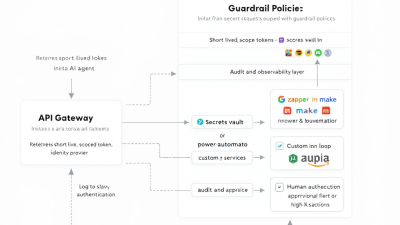
Custom Gateway Pattern: Brokered Access via API Gateway, Per-Action Scopes, and Attribute-Based Access Control
– Brokered access: Agents never call core services directly. They call a Gateway API that enforces identity, policy, and transformations.
– Per-action scopes: The gateway exchanges the agent’s token for a short-lived, action-scoped token (e.g., “invoice.read.self”). Deny if the token lacks the action claim.
– ABAC: Use attributes (department, data classification, transaction value) in policy decisions. Azure API Management policies let you evaluate JWT claims and headers per request.
– Defense in depth: JWT validation, request schema checks, PII redaction, outbound rate limits, and anomaly detection rules via policy scripts.
Observability and Auditability: End-to-End Traces, Immutable Logs, Evidence for Audits (NIST/ISO Alignment)
– Traceability: Correlate every agent action across platforms with a unique correlation ID. Log who/what/when/why, including scopes, acr, and approval IDs.
– Immutable logs: Write to append-only storage with periodic signing. Retain per your data residency and compliance profile.
– Audit evidence: Map events to control objectives (approval required, step-up performed, data classification enforced). You’ll need this to demonstrate alignment with NIST ZTA and AI governance frameworks.
Human-in-the-Loop by Design: Exception Queues, Approval UX, Break-Glass Procedures, and Escalation Trees
– Approval UX: Present humans with the minimal context and a verifiable summary (diffs, amounts, recipients). Require explicit confirmation for sensitive actions per OWASP LLM08.
– Exception queues: Route uncertain or policy-violating attempts into a review queue rather than failing silently.
– Break-glass: Maintain emergency accounts and bypasses with time-boxed, logged access and post-incident review.
– Escalation: Define who approves what, with back-ups and SLAs to prevent process stall.
Testing Your Controls: Permission Fuzzing, Prompt-Injection Drills, Red-Team Scenarios, and Replay Sandboxes
– Permission fuzzing: Attempt actions with systematically reduced scopes to ensure denial occurs as expected; then expand to verify least privilege suffices.
– Prompt-injection drills: Seed inputs with adversarial instructions and verify guardrails (tool allow-lists, gateway policies) prevent harmful side-effects. Use scenarios from OWASP LLM Top 10.
– Red-team runs: Simulate token theft and lateral movement. Validate that revocation, DLP, and segmentation limit blast radius.
– Replay sandboxes: Re-run production traces in a safe environment to validate new guardrails before release.
Latency and Cost Considerations: Balancing Short-Lived Tokens, Extra Hops, and AI Model Usage Efficiency
– Token lifetimes vs. chattiness: Short-lived tokens increase exchanges; mitigate by batching calls and reusing connections within a bounded window.
– Gateway overhead: Keep gateway policies lean and cache allow-list decisions where safe. Co-locate gateway and services to minimize network RTT.
– Model usage: Use function/tool calling to reduce prompt tokens. Cache intermediate results and apply call budgets to avoid runaway loops.
SMB-Friendly Rollout Plan: 30-60-90 Day Roadmap with Quick Wins and a Maturity Checklist
– Day 0–30 (Foundations)
– Inventory agents, connectors, and secrets. Classify data flows.
– Enforce platform allow-lists (e.g., Zapier App restrictions). Apply Power Platform DLP policies.
– Segregate environments and service accounts. Rotate obvious long-lived keys.
– Day 31–60 (Controls)
– Introduce a gateway for sensitive APIs with JWT validation and rate limiting.
– Implement just-in-time credentials for at least one critical integration (e.g., DB read via Vault dynamic secrets).
– Add human approvals for top 3 risky actions; implement step-up using OIDC acr on the identity provider.
– Day 61–90 (Maturity)
– Expand per-action scopes and ABAC policies. Add immutable logging and correlation IDs.
– Run red-team drills and fix gaps. Formalize break-glass and incident runbooks.
– Create a dashboard for guardrail coverage and a quarterly rotation calendar.
Compliance Mapping: Connecting Controls to NIST AI RMF and ISO/IEC 42001 Requirements
– Governance: Policies for least privilege, tool allow-lists, and DLP align with AI risk controls (policy definition, data governance).
– Map controls:
– Identity and access: Scopes, app roles, step-up (acr), JIT credentials.
– Data protection: DLP at connector plane, PII filtering at gateway, environment isolation.
– Operations: Immutable logs, traceability, approval workflows, incident runbooks.
– Evidence: Maintain config baselines, policy code, and audit logs linked to each high-risk workflow.
Operational Runbook: Incident Response for AI Agents—Credential Compromise, Abuse Detection, and Recovery
1) Detect: Alerts on anomalous volumes, denied policy spikes, or unusual acr downgrades.
2) Contain: Revoke tokens, disable agent identities, block at the gateway (IP/app/route).
3) Eradicate: Rotate secrets, patch prompts/tool lists, fix mis-scoped permissions.
4) Recover: Re-enable with short-lived credentials and monitored mode; replay audit to confirm integrity.
5) Learn: Post-incident review; update tests and playbooks; adjust DLP and allow-lists.
Reference Architectures: Sample Diagrams for Connector-Based Flows and Custom-Runner Setups
– Connector-first (Zapier/Power Automate):
– Agent -> Orchestrator (Zap/Flow) -> Gateway (JWT validate, DLP, schema) -> SaaS API
– Identity: Service principal per flow; per-action scope minted by gateway; approvals via human task.
– Custom runner (n8n/Make + internal APIs):
– Agent -> Runner (n8n/Make) -> Vault (dynamic secrets) -> Gateway (ABAC) -> Internal Services
– Identity: Workload identity federation to cloud; ephemeral credentials per job; logs to append-only store.
Buyer’s Checklist: What to Ask Vendors About Scopes, Logs, Data Boundaries, and Tenancy
– Scopes and roles
– Can we define custom, granular scopes and app roles?
– Do you support per-action or per-tool allow-lists?
– Authentication
– Do you support OIDC step-up via acr and phishing-resistant MFA?
– Can workflows run under service principals with least privilege?
– Secrets
– Are credentials short-lived or dynamically issued? Do you integrate with Vault or workload identity federation?
– How are secrets stored (encryption at rest, KMS) and accessed at runtime?
– Guardrails
– Can we enforce DLP rules and PII filtering? Are there policy-as-code hooks or a gateway integration?
– Observability
– Do you provide immutable, exportable logs with correlation IDs and scope/acr details?
– Can we stream logs to our SIEM in real time?
– Tenancy and data boundaries
– Is data processing region-selectable? How is tenant isolation enforced?
– What are your backup/retention defaults and deletion guarantees?
– Admin controls
– Do you offer organization-wide app restrictions or connector blocking?
– Is RBAC available for folders/projects/environments?
Closing Thought
Zero-trust for AI agents isn’t about saying “no.” It’s about turning “yes” into a precise, provable, and reversible decision—every time. With scoped tokens, just-in-time credentials, step-up authentication, and guardrail APIs, you can let agents move fast without breaking things you can’t fix. Start small, instrument deeply, and evolve toward policy-as-code everywhere.
Citations and Further Reading
– Zero-trust foundations: NIST SP 800-207
– Agent risk patterns: OWASP LLM Top 10 (LLM08)
– Scopes and app roles in Entra: Permissions and consent, App roles
– Step-up with OIDC: acr claim
– Dynamic secrets: HashiCorp Vault
– Gateway guardrails: Azure API Management policies, Validate JWT
– Power Platform DLP: DLP policies
– Zapier org controls: App restrictions
– n8n security: Hosting and security
– Workload identity federation: GitHub Actions OIDC pattern